

Understanding the Lettre Recommandée avec accusé de réception (Registered Letter)
Wondering what is a lettre recommandée ?
If you’re navigating administrative tasks in France, you might have come across the term “lettre recommandée”. But what exactly is a lettre recommandée avec accusé de réception, and why is it important? Let’s break it down! 📨
What is a Lettre Recommandée? 🤔
A lettre recommandée (registered letter) is a secure way to send important documents through the postal service. Unlike a regular letter, a lettre recommandée provides proof that your letter was sent and received. This is crucial for official and legal communications.
Here’s how it works:
- Proof of Sending: When you send a lettre recommandée, you get a receipt as proof that it was dispatched.
- Proof of Delivery: The recipient must sign upon receiving the letter, and you get a confirmation of delivery.
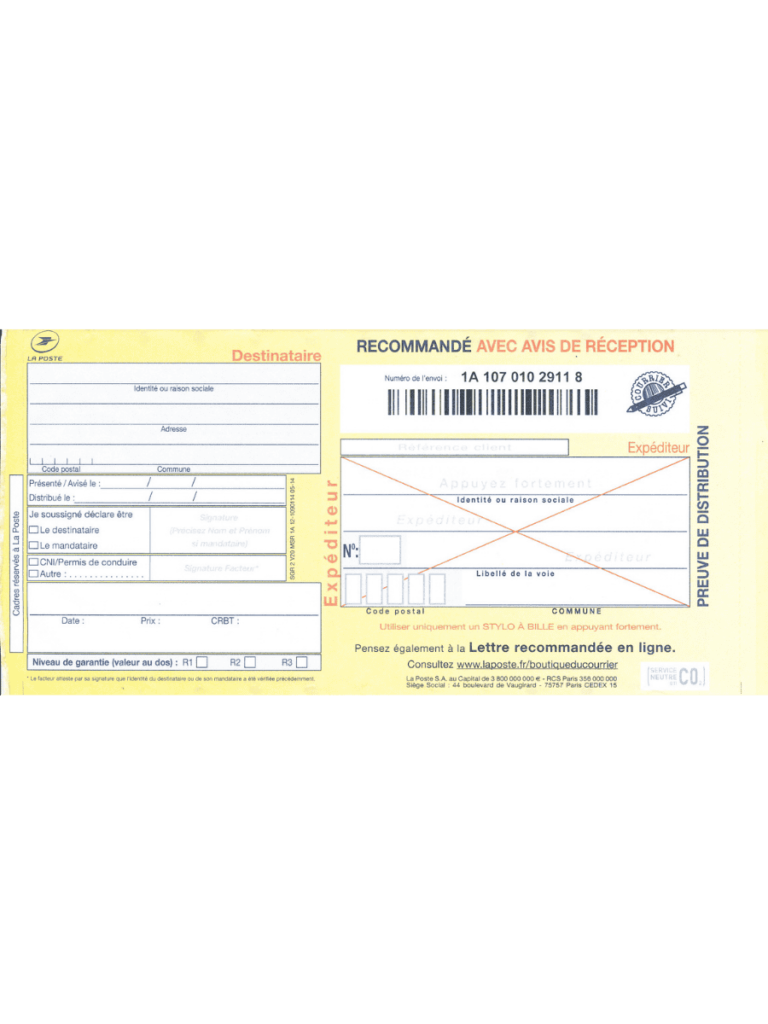
What is the Accusé de Réception? 📑
An accusé de réception (receipt of acknowledgment) is a crucial part of a lettre recommandée. It’s the official document that confirms the letter was received by the recipient. This receipt can be used as evidence in legal matters or disputes.
Why Use a Lettre Recommandée? 🤝
A lettre recommandée is often used for:
- Legal Notices: Such as terminating a contract or notifying a company of a dispute.
- Important Documents: Sending sensitive documents where proof of receipt is needed.
- Formal Communication: Any communication that requires a verified record.
Using a lettre recommandée ensures that your important correspondence is handled with the highest level of accountability and traceability. 🏛️
Key Points to Remember 🔑
- A lettre recommandée provides proof of sending and proof of delivery.
- The accusé de réception is a receipt confirming that the letter was received.
- Use a lettre recommandée for important or legal communications.
By understanding what a lettre recommandée is and how it functions, you can ensure that your important documents are handled correctly and securely. 📬
FAQ❓
A lettre recommandée provides proof that a letter was sent and received, making it ideal for formal or legal communications.
An accusé de réception is a receipt confirming that the recipient has received the lettre recommandée.
While a lettre recommandée is commonly used for formal or legal matters, it can also be used for any communication where proof of receipt is necessary.
No, a lettre recommandée is different from a regular letter because it includes additional proof of sending and delivery.
Similar Posts
What is a Justificatif de Ressources CAF? 📝
ByMargauxUnderstanding Justificatif de Ressources CAF When applying for benefits from the CAF (Caisse d’Allocations Familiales) in France, such as housing aid (APL), you may be asked to provide a justificatif de ressources CAF. But what is a justificatif de ressources CAF? In some cases, this can be an attestation de ressources, which is a self-written…
What is a Titre de Séjour? 🤔
ByMargauxWhat is a french Titre de Séjour? 🤔 If you’re an international student planning to study in France, one essential document you’ll need is a french titre de séjour. But what is a titre de séjour exactly? In simple terms, it’s a residence permit that allows non-European Union nationals to live and study legally in France…
Can I work in France as an International Student ?
ByMargauxIf you’re an international student planning to study in France, you might be wondering if you can work in France while studying. The good news is, yes, international students can work in France! However, there are some rules and restrictions you need to be aware of. WORK IN FRANCE AS A NON-EUROPEAN STUDENT 🌍 Here…
What is Campus France? 🌍
ByMargauxWhat is Campus France? 🌍 If you’re an international student considering studying in France, you may have come across the term Campus France. But exactly what is Campus France? Campus France is the national agency responsible for promoting French higher education abroad and assisting international students and researchers in their plans to study in France….
5 reasons to have a French bank account as a student in France ! 💳
ByMargauxIf you have just arrived in France or are planning to move there, opening a French bank account is a crucial step. Here are 5 reasons why you absolutely need a bank account in France. Layz to read ? Check out our Youtube video to know all about French bank account !🔥 1. EASE YOUR…
How to Do the APL Request: A Step-by-Step Guide for International Students in France 🎓
ByMargauxhttps://youtu.be/Eta99yM8tnA?si=I6C3Qu8Gl8AzvZSq If you’re an international student living in France, knowing how to do the APL request (Aide Personnalisée au Logement) can help reduce your housing costs significantly. APL is a French housing benefit available to students, including internationals, to help them cover their rent. If you’re unsure how to go about it, our YouTube tutorial provides…
One Comment